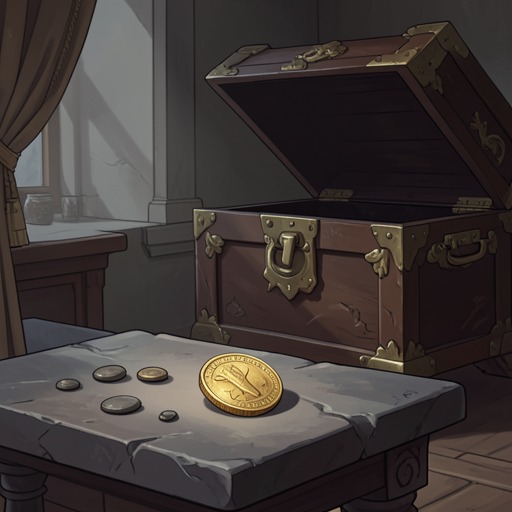
The Geographic Limitation of Fairy Gold
One Thousand and One NightsThe Geographic Limitation of Fairy Gold makes the jinn’s spun treasure valuable only within the bounds of its territory. Della’s father explains that the gold looks indistinguishable from real gold until it is taken quite a distance out of the city; the rule turns an apparent fortune into a geographically limited counterfeit and helps explain both the jinn’s powers and the practical stakes of the theft.
Definition and Operation
Fairy gold is straw transformed by the jinn into material that resembles gold. Its deceptive appearance does not establish its lasting value: the difference between it and genuine gold becomes apparent only after it has been carried far enough from the city, a boundary Della’s father connects to the jinn’s territory. He therefore calls the gold worthless, despite its convincing appearance among the treasure in his hidden chamber.
The limitation makes the jinn’s magic powerful but bounded. The gold can pass as wealth where the jinn’s territorial influence holds, yet it cannot simply be treated as portable, ordinary treasure. Its value depends not only on what it looks like but also on where it is taken.
Discovery and Consequences
After Tad uses the Magic globe to watch Zaen and Della’s father enter the treasure chamber, he sees the two men distinguish the missing valuables. Della’s father points out the pile of straw-like fairy gold and contrasts it with the genuine coins and jewels, of which only a few handfuls have disappeared. The distinction matters to their assessment of the break-in: the thief has taken a fortune in fairy gold, but the stolen-looking gold is not equivalent to real wealth.
The rule also shapes the father’s expectation that the thief may return. He reasons that the intruder could not carry everything away and notes that the lamp disappeared before he noticed the theft. The magical gold’s apparent abundance thus coexists with its limitation, while the chamber still contains genuine treasure that the thief might seek.
Connection to the Jinn’s Magic
The father’s account associates the restriction with the jinn’s territory rather than with the gold’s visible form. The limitation is therefore an essential condition of the transformation: the jinn can spin straw into fairy gold, but the resulting material does not retain the status of real gold beyond the relevant territory. Later, Tad’s library research turns up a story about a miller’s daughter tricked by a creature that spins straw into gold, which seems possibly to concern the same jinn, though Tad finds no reference to a lamp in that story.
The distinction between fairy gold and genuine treasure echoes the terms of the father’s dealings with the jinn. His first wish gave him knowledge of how to obtain wealth rather than wealth itself, and he used that knowledge to acquire real treasure. The geographic rule clarifies why magical gold could appear plentiful without providing the same dependable inheritance as genuine coins and jewels.